Five questions, each one attached to something you can go and look at. It is an inspection grammar.
Take the napkin back out.
Five questions are written on it, and together they are the Blank Collar framework. Nothing to calculate, nothing to score. Four conditions and one amplifier, five questions you can put to a real organization and answer with evidence. It is an inspection grammar. The last chapter is what became of my faith in impressive-looking structure. What replaced it is plain: five questions, each one attached to something you can go and look at.
Vision is the organization-wide direction and decision filter. The question is whether the direction can decide something, whether a proposal can be run against it and come back yes or no without the founder in the room.
Data is the recorded reality available to the work. The question is whether the record can be trusted, whether the same question asked twice by two people returns the same answer.
Process is how the work actually moves, including its handoffs and exceptions. The question is whether the movement survives absence, whether someone else could restart it from what is written down.
Human Experience is whether the people carrying a change can carry it: adopt it, challenge it, modify it, improve it. The question is whether the change lands or gets worked around.
AI is the amplification touching the workflow: which systems are deployed, on what work, with what permissions and review. The question is what that amplification would meet if it were turned up. And the deployment is something you manage, not weather. Model choice, permissions, evaluation, routing, human review, and cost are decisions with names attached, and they can be as weak or unready as any process.
To keep these concrete, this book carries one example the whole way, and I will label it before you meet it: schematic, not a case or proof. No company, no people, no numbers. A customer disputes a service renewal, says they tried to cancel, and asks for a refund. The request moves among frontline support, an approval owner, and billing. Somewhere in that triangle, definitions may not match: does cancellation attempted mean the same thing to support and to billing? Authority may not be written down: who can approve the exception, and does the reason travel with the decision? An AI system may retrieve the policy and draft the reply, and it may not invent authority it was never given or settle the fairness question itself. Run the five questions across that small workflow and you can feel what each one would make you inspect, before any of them is answered. The schematic stays stable through the book so you can watch one piece of work move through the whole method. Each time it appears, your job is to translate it to one real workflow of your own.
Now for the operating rules, because the last framework died for lack of them. There is no total score, and nothing is added or multiplied. Each question returns one of four states: Works, Wobbles, Zero, or No reading. Anchor the states to the artifact rather than to a feeling. Works means an unrelated qualified reader reaches the same answer from the record. Wobbles means the record still needs a resident translator to read the same way twice. Zero means it cannot be reproduced at all. No reading means the evidence is missing or the test does not apply, and it is not a zero; a company that cannot grade a condition has learned something different from one that graded it and failed. Whether two readers land on the same state, on the same workflow, is the reproducibility this framework's predecessor lacked, and it is the one property only real readers can confirm, which is why the states are offered as a discipline to test and not yet a settled instrument. Vision is read company-wide. Data, Process, Human Experience, and AI are read against the same selected workflow wherever possible, because grades pulled from five different corners describe five different companies. The weakest condition supported by valid evidence names a constraint to investigate. It does not prove that condition caused anything, and a low grade from one workflow has to be confirmed before money, roles, or policy move. And when most of the readings come back No reading, do not read that as the framework working; read it as the framework not yet applicable here, which is its own honest finding.
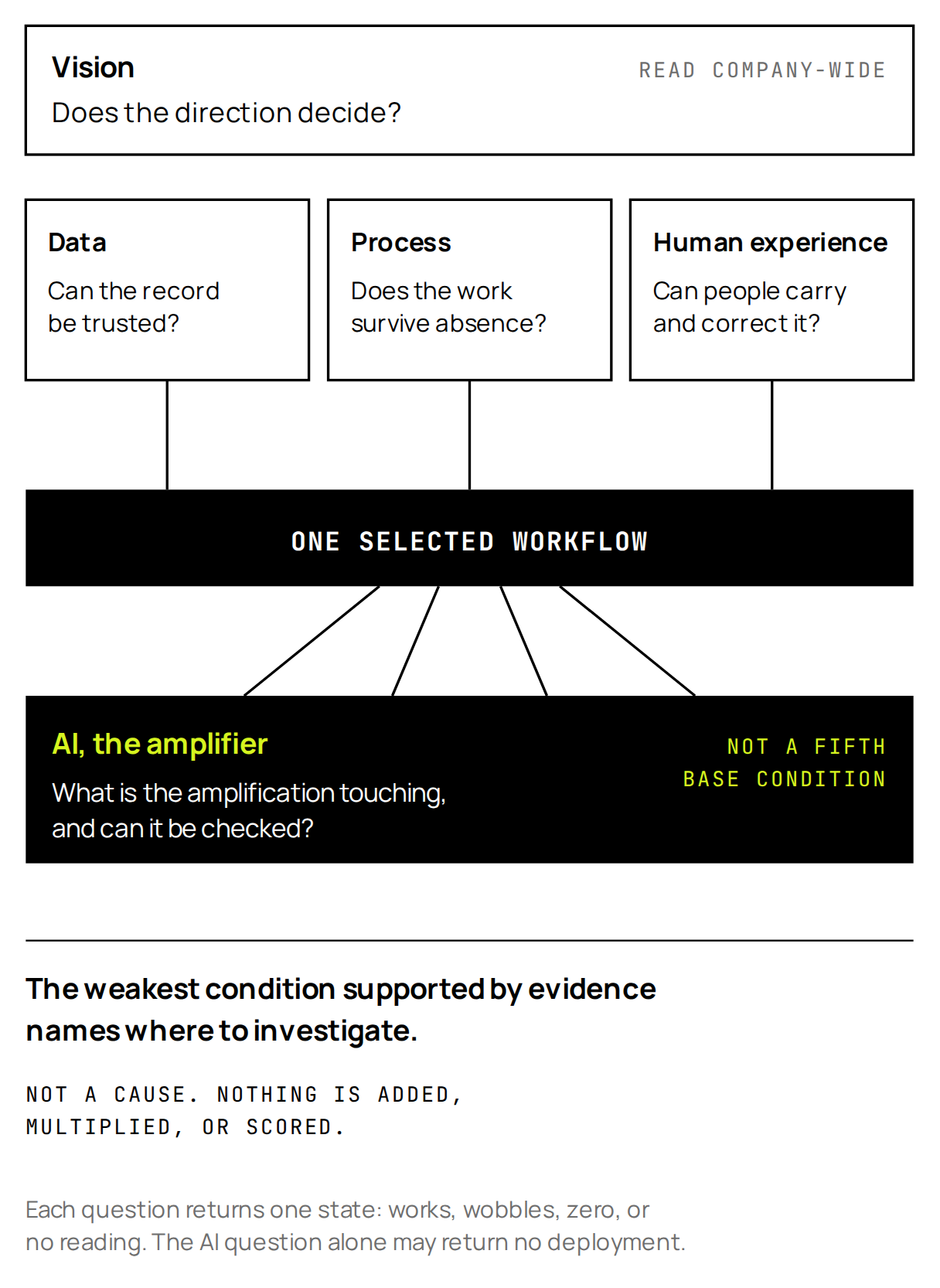
One concession bounds all of it. The framework tests whether work can become inheritable, restartable and checkable and improvable without its current owner. It does not establish that the inherited work is correct, or that the organization is aimed at a future worth reaching. A company can pass all five and be efficiently wrong. Even with that limit, an inspection this honest is still more diagnosis than most companies have ever run on themselves.
The claim I have to defend
Here is the proposal the rest of the book leans on, so push on it. Within the knowledge-work scope defined here, these five classes of question form a candidate inspection grammar. They are not the necessary and sufficient causes of every outcome; capital, regulation, market position, timing, incentives, and plain external shock stay on the table as explanations these questions do not absorb. Nor do they make two different organizations the same object underneath. The narrower claim is about legibility. Where there is direction, recorded reality, recurring work, people carrying it, and machine amplification arriving, the questions propose something concrete to inspect. Whether that proposal travels reliably is something use must establish, not something the framework can declare about itself.
Since an unfalsifiable framework is precisely what I just finished burying, here is what would weaken this one. Show me a relevant organization where one of the five questions has no meaningful referent, and the proposed range shrinks. Show me repeated prospective cases where the weakest confirmed condition fails to constrain the result, and the operating logic is in trouble. Show me a rival diagnostic that guides decisions more reliably, and this one should retire the way its predecessor did.
What follows is a range demonstration, chosen to stretch the questions across organizations that have little in common. Range is what it shows. It is not proof.
How far the questions travel
A bank. JPMorganChase's 2024 annual report says the firm launched LLM Suite to more than 200,000 colleagues in 2024, in a controlled environment designed to protect customer and company data. The framework question sits under the headline: what condition does an organization's data have to be in before an internal deployment at that scale is safe to attempt, and what did the controlled environment have to control for? The firm credits earlier technology investment for its current products and services, which is the firm explaining itself. What the public record does not carry is any internal evidence of data condition, what failed along the way, or whether readiness caused the result. A rival explanation, that scale and spend alone carried it, stays live.
A medical group. A Permanente Medicine report says 7,260 physicians used ambient AI scribes across more than 2.5 million patient encounters during a 63-week evaluation. It describes time and survey outcomes, and use was uneven across physicians. The framework question is Human Experience: what decides whether a tool lands in the hands of the people carrying the work, and why did some physicians run with it while others left it alone? The unevenness is the interesting fact, and the report does not explain it. Whether the difference was workflow fit, specialty, training, or trust is exactly the internal evidence an inspection would need. Without it, the case shows that adoption varies. It does not show why.
A factory. BMW reports that during a 2025 deployment at its Spartanburg plant, a humanoid robot supported production of more than 30,000 X3 vehicles, moved more than 90,000 components, and accumulated about 1,250 operating hours, with production IT, occupational safety, production-process management, and shop-floor logistics involved early. The framework question is Process: how much written, inspectable process had to exist before the most physical and safety-bound environment in this set could hand work to a machine at all? BMW's report does not say written process caused the result, and I will not say it either; a plant is thick with explanations, from engineering depth to capital, that sit outside the five questions. What the case shows is narrower: the questions travel into physical operations and find something to attach to.
Three organizations, three different questions doing the work, and a limit to state with them. My evidence and my working life are in knowledge work: organizations whose product is decisions, analysis, documents, and service. That is where this book's cases sit and its prescriptions hold. The framework can inspect a plant, and the factory paragraph is not decoration, but where physical constraints, safety regimes, and formal labor institutions bind, this book is a lens, not an operating manual, and I would rather draw that line myself than have a plant manager draw it for me.
One correction runs the other way, toward the small. Below roughly thirty people, named-person dependency is often the structure of the company, not a defect in it. The founder approves things because the founder is the company; the single bookkeeper holds the whole function because there is one of them. Grading that at zero for having named owners is grading it for being small. The question that fits the scale is the two-week absence test: what stops when this person is gone for two weeks, and could a capable replacement restart it from an artifact? A small company that passes that test has made its work inheritable, whatever its org chart looks like. The questions travel. They do not, on their own, validate anything.
The diamond in the room
If you have sat through enough transformation decks, you have been waiting to say it, so I will say it for you: people, process, technology. Harold Leavitt's organizational model is an ancestor of what I am about to hand you, and I would rather own that than pretend the framework arrived from nowhere. The Blank Collar framework is a descendant of that thinking, and that older model earned its long life by being useful.
What this framework changes are design choices, and they deserve to be judged as choices, not as corrections to people who missed the obvious. Direction is explicit here, a condition to inspect, where many applications of the older models left it implicit. Recorded reality is explicit, because machines now consume it directly. The human term is defined as adoption and correction capacity, whether people can carry, challenge, and improve a change, which is narrower and more testable than a box labeled people. And AI enters as an amplifier touching the whole system, which changes the audit question from whether each component is in acceptable shape to what the amplification will meet.
Predecessor models were not blind to these concerns in every interpretation, and this framework is not better for being newer or for having cut more away. Whether the design choices earn their keep is what the tests and decisions in the following chapters have to demonstrate.
The other company
One more reading before Vision gets its chapter, because the framework has a property I noticed only after the demolition: its questions have a second referent. A person has a direction, or is following someone else's. A person's work leaves a record. A person's week moves through recurring methods, mostly unwritten. A person experiences their own working life from the inside, and the amplification is already touching whatever they do. The five questions attach to a career the way they attach to a company, as questions.
I want to be careful about what that licenses. The company tests you are about to meet, their samples, thresholds, and evidence rules, do not transfer to a career unchanged, and chapter eighteen builds the personal instrument properly. What carries over now is the one consequence this book has already argued. The person who makes their repeatable work inheritable has made their old value portable, and their growth depends on what they take responsibility for next: the exception the procedure cannot settle, the method that does not exist yet, the people learning the one that does. Carry that double reading through the next chapters lightly, and let the company version do the work first.
The company version begins smaller than any transformation program you have been sold. Select one real workflow: a piece of recurring work with a beginning, an end, and a consequence someone cares about. From there, Data reads that workflow's number, Process maps that workflow's movement, Human Experience reads how change lands there and how objections travel up from it, and AI reads whatever deployment currently touches it, or returns No reading if none does. Vision alone stays company-wide, because direction is not a property of a single workflow. That one selection is the instrument's first act, and it is why the readings that follow can be compared at all: five questions, one specimen, no tour of the whole company required.
Which leaves the condition you cannot read from any single workflow, and it is the right place to start the walk. Every organization has a direction somewhere, in a statement, in a founder's head, in the pattern of what got approved last year. The question the next chapter has to answer is whether that direction can do the one thing a direction is for. Can it decide? Can it produce a decision when the author of the direction is not in the room?