Succession is not a replacement event. It is evidence that leadership has become an organizational capability.
A redesigned workflow hits a ceiling the moment you notice where its hard cases go. You made the routine inheritable. You gave the exceptions a path. And the path still ends at one person: the leader whose approval, presence, or judgment every consequential case eventually requires. The instrument this book has aimed at workflows now has to turn upward. A company whose leadership cannot be inherited has only moved its single point of failure to the top of the building and called it seniority.
There is a contradiction worth naming, and I will name it as a tendency, not a verdict on anyone. Leaders often ask everyone below them to document, delegate, and remove dependency, while their own status, their board's approval, and their sense of their own worth all reward staying central: being the one who decides, the one who knows, the one who rescues. Where those incentives pull, a leader can preach inheritability and quietly practice indispensability, and the organization reads the practice, not the sermon.
Define the title before it misleads.
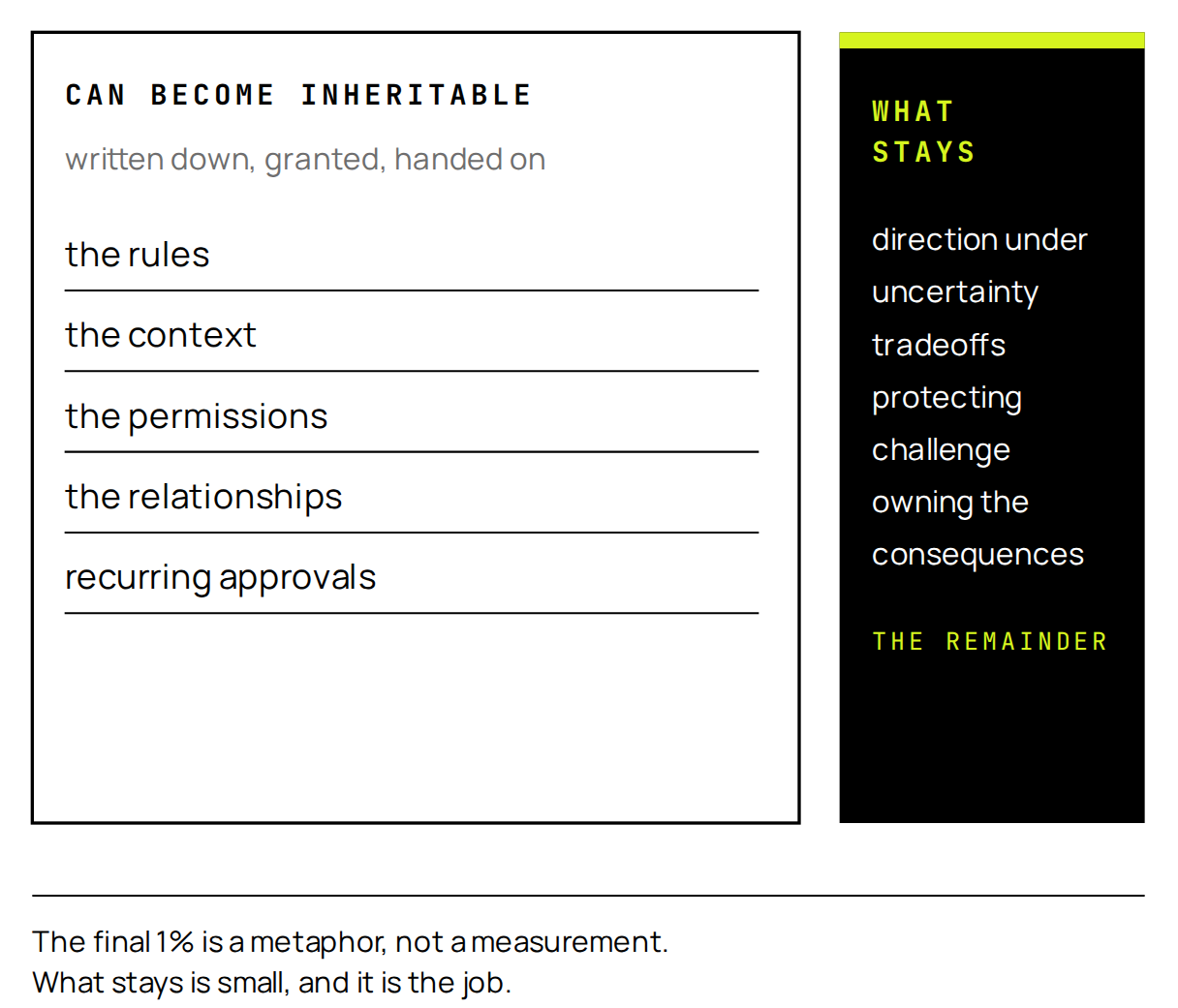
The final one percent is a metaphor for the responsibility that remains after repeatable leadership work becomes inheritable. It is not a measured share of time, decisions, or value.
It is not a claim that a leader should do one percent of the work, or that ninety-nine percent of leadership automates. It names the residue: the part of leading that cannot be reduced to a stable, repeatable method and handed off. Setting direction under real uncertainty. Making the tradeoffs that have no clean answer, where any choice costs something and someone has to own the cost. Allocating scarce authority and resources when the claims are all legitimate. Protecting the people who challenge the direction. Revising the system when it stops fitting the world. And carrying the consequence when a call goes wrong. Routine management does not disappear underneath that, and pretending it does would be its own fantasy. Plenty of leadership work is schedulable, delegable, and inheritable, which is exactly the point: the schedulable part should become inheritable so the residue gets the attention only a person can give it.
Sort the leadership work the way you sorted a workflow. A large share of it is recurring and method-shaped: approvals that follow a rule, the rationale behind decisions that others keep having to guess at, the context of key relationships, the permissions that let work proceed, the external obligations the company must honor, and the authority to act in a crisis. All of that can be made accessible through authorized continuity arrangements, so a qualified successor or standing continuity role can reach it when needed, without the leader personally in the loop. Accessible does not mean published. Confidential material stays protected and travels only through the authorized channels built for it, which is a different thing from living undocumented in one person's head. What remains after the sorting is the accountable residual judgment, the calls that do not reduce to a rule. None of that means routine management vanishes, and none of it says a machine can lead. The recurring part is made inheritable precisely so the part no rule covers can get a person's full attention.
Divide the work honestly, and use the Blank Collar framework on leadership the way you used it on a workflow, without inventing a leader's version of a card. That is the book's two moves turned on the leader. Make the leadership role inheritable, then re-form onto the residual judgment no method can carry. The leader is not exempt from the second move; the leader is where it bites hardest. Some leadership work should become inheritable: the recurring approvals that follow a rule, the knowledge that lives only in the leader's head, the relationships that would strand the company if the leader left, the decisions that could be made against clear criteria by someone closer to the evidence. And some leadership work stays accountable judgment that does not reduce to a method. The skill is telling the two apart honestly, and the difficulty is that the sorting is easy to get wrong in the flattering direction, calling a delegable approval a matter of irreplaceable judgment because it happens to be one's own.
Recast succession in that light.
Succession is not a replacement event. It is evidence that leadership has become an organizational capability.
Succession is not a name filed away for an emergency. It is the ongoing condition in which direction, the reasons behind key decisions, the critical permissions, the external obligations, and the authority to act in a crisis can survive the leader's absence. A successor inherits a role and its operating context, not the incumbent's personality. A company that has made leadership inheritable can hand over the role because the role was built to be handed over, not because it found a match for one person.
What would count as evidence that leadership has become an organizational capability? That an authorized successor or a qualified continuity role could, if the leader were absent, interpret the direction the way the leader would, reach the context a decision requires, use the permissions the role carries, act inside defined boundaries, and explain why a decision went the way it did. Those are observable, and they are observable in ordinary operation, not only in a crisis. Run a bounded absence exercise and you can watch which of them hold and which break. It is a probe and not a proof: one absence, tabletop or real, shows you the gaps it happens to expose, and not the ones it did not touch. And keep the aim straight while you read it. The goal is continuity of the role and its operating context, not a successor who imitates the incumbent's manner. A company that can only be led by someone who behaves exactly like the current leader has not made leadership inheritable. It has made it a costume.
Distributed authority is the mechanism, and it has to be defined precisely, because the word gets used to mean two things it must not. It does not mean consensus, and it does not mean abdication. It means decisions move toward the people or systems closest to valid evidence, inside explicit boundaries, with defined permissions, clear escalation routes when a case exceeds the boundary, and review rights that let the leader see what was decided and correct the pattern. A decision delegated without a boundary is abandonment. A decision delegated with one is leverage.
See how the parts hold each other up. A boundary says how far a delegated decision may go. Permissions grant the access to act inside it. An evidence requirement says what a decision has to rest on, so authority follows information instead of rank. An escalation route carries the case that exceeds the boundary back up before it does damage. Review rights let the leader see the pattern of decisions and correct the design, not each call. And revocability means authority granted can be withdrawn when it is misused, which is what makes granting it safe in the first place. Remove any one and the others weaken: permissions without boundaries is a blank check, boundaries without escalation traps the hard case, review without revocability is watching without a brake. Decisions can move to a person or a system close to valid evidence, and all of this operates inside the existing hierarchy rather than dissolving it. The leader stops making each decision and becomes accountable for the system that makes them, which includes owning it when the system decides badly.
And challenge has to be made real, not gestured at.
If challenge cannot change a decision, authority is distributed only on paper.
An organization that says it welcomes dissent and never lets dissent alter an outcome has built a suggestion box, not a challenge system. For challenge to be real, evidence needs a route to contest the direction without the person raising it paying a price, and that route has to be able to change the decision at the end of it. None of which guarantees the challenge is right; plenty of confident challenges are wrong. It guarantees only that the organization can be corrected by evidence instead of waiting for the leader to notice, which is the difference between a system that learns and one that depends on a single person's attention span.
Making challenge operational does not require a program, and it does require three plain things. The challenger needs a route that does not cost them to use, because a channel people are punished for using is decorative. The decision record has to show what evidence was weighed and why the outcome changed or held, so a challenge produces a visible response instead of vanishing into a manager's inbox. And a pattern of evidence raised and repeatedly ignored is itself a finding about the system, not about the persistence of the person raising it, because a system that can hear challenge only when it is convenient cannot be corrected by inconvenient truth. None of this assumes the challenger is right. Plenty of well-argued challenges are wrong, and a good challenge system rejects them on the evidence and records why. What the system guarantees is not correctness but correctability: that a decision can be moved by evidence when the evidence is strong, instead of holding only because the person who made it has not yet changed their mind.
Turn Chapter 19's filter on the leader, once, because it applies with full force here. If a leader's reward, identity, or standing with the board depends on holding exclusive knowledge, on repeatedly rescuing the company, or on personally signing off, then inheritable leadership directly threatens the leader's own incentives, and the org will feel that threat as friction it cannot explain. The honest measures of a leader run the other way: whether succession is real, whether the decisions delegated away are being made well, whether judgment is developing in the people below, and whether operations recover from the leader's absence. I am not prescribing how to pay for any of that, which is fenced by governance and law and is not this book's to specify. I am saying it is what to look at.
Write down one leadership inheritance statement, and keep it a statement rather than a recipe. It identifies what can operate without the leader's intervention, which authority transfers now and not someday, who is authorized to act, what evidence constrains them, who is entitled to challenge, and which consequences stay with the leader because they cannot be delegated. That last clause is what keeps this from being abdication in a nicer suit.
Watch what people become as this takes hold. Direct reports stop being couriers who carry information up for a decision and carry the decision back down; they become people authorized to decide within their boundaries. Potential successors stop being understudies and start accumulating real context and real consequence, which is a large part of how judgment develops. And the leader moves off the approval bottleneck and toward being the designer and steward of the decision system itself, which is a larger job than approving things, not a smaller one.
The objection is fair and has to be answered. Distributed authority can produce drift, inconsistency, and risk that hides until it is large. True, and the answer is not to pull the authority back to the center; it is to bound it. Explicit limits, evidence requirements, review on a schedule, and authority that can be revoked when it is misused are what make distribution safe, and none of it removes the leader's accountability, because delegation never does. A leader who delegates a decision still answers for the system that produced it.
A leader does not become dispensable when the company can operate without constant intervention. The leader becomes responsible for a larger system.
That is the whole inversion this chapter asks for. The leader who can step away for a fortnight and come back to a company that ran, decided, and corrected itself has not proven themselves unnecessary. A single absence is a probe, not a certificate, and it does not prove leadership has become fully organizational. What it does show, when it goes well, is that some of leadership has moved from the property of one person toward a capability of the organization. That is what frees the leader to own the part no system can carry: the ambiguous, consequential judgment that remains once the method-shaped work has been handed down. The work becomes inheritable. The judgment stays the job.
I have spent this book asking companies and people to expose their work to tests they do not control. The next chapter turns that demand on me. Large claims are easy to make and easy to protect with explanations after the fact. I am going to state where the argument can lose, and I am going to distinguish those failure conditions from public tests that have not yet earned the name.