Make the repeatable work inheritable. Grow into what the inherited system cannot settle.
Somewhere this week, in an interview room you are paying for, your most conscientious interviewer is rejecting the person this book is named after.
The candidate's resume is the first problem. Five industries in twelve years. Operations, then marketing technology, then a logistics company, then two things that do not fit in the same sentence. Your applicant tracking system has already scored it low, because the system was tuned to find progression, and this is not progression. It is wandering. Your interviewer, who is good at her job, sees the same thing the software saw and asks the question she has been trained to ask.
Walk me through your process.
And here is the strange part: this candidate answers it well. Better than well. For the repeatable layer of the last job, there is a crisp account of the method, and then a sentence interviewers are not trained to hear: I documented that whole workflow before I left, my successor ran it from the handbook within a month, so the process is genuinely not the interesting part. Then the candidate starts describing the interesting part, which is how a pattern from the logistics years exposed a problem the marketing organization could not see, what the options were, which one they chose, and what it cost when part of the choice went wrong. The interviewer's scorecard has rows for method, tools, and structure. It has no row for any of that. She writes down: unfocused, jumps between topics. The next candidate recites a clean, numbered method, polished over forty interviews, owns no decision and mentions no mistake, and gets the offer.
Here is what nobody in that room says out loud. Walk me through your process verifies exactly one thing: the layer of the job that can be handed over. It is a fine question, as far as it goes. The trouble is that it is the only question the machinery asks, so the candidate who is purely process scores highest, and chapter three told you what is now true of work that is purely process. The signals that actually separate the first candidate, framing an unfamiliar problem, moving a pattern across domains, deciding under ambiguity and owning the result, never touched the scorecard.
You did not build a bad filter. You built an excellent filter, decades ago, for a world where the recitable method was the whole hire. That world is ending, the filter is still running, and this chapter is about the person it rejects.
Three collars, three ways of checking
Before they became job categories, the collars described something visible about work, and each one answered a question every organization has to solve: how do you verify work you did not do yourself?
Blue collar work was verified by looking at the thing. The collar was dark because the work marked it, and nobody needed the machinist to describe his method, because the part either fit or it did not. The knowledge behind the part, the sound a cut makes when it is wrong, stayed in the man, unwritten, because writing it down was never required for payment.
White collar work could not be verified that way. The output was invisible, a decision, an analysis, a coordination, so verification had to run on paper. And so the white collar built the great apparatus of proof that we now mistake for work itself: the credential, the title, the job description, the process map, the status report, the annual review, the hours visibly spent at a desk. Every artifact on that list exists to demonstrate that invisible work happened.
I spent close to twenty years inside that apparatus, building parts of it, and I believed in it. It took me most of those years to see what it actually was. A century of white collar work writing itself down, so that it could be managed. And describable, it turns out, is the same word as inheritable. The machines did not eat white collar work because it was easy. They ate it because it was documented, disciplined, and proud of both.
Which leaves a third collar, and the name works differently. Blue and white were named for what you could see on the person. Blank is named for what stays empty on the form after the honest answers are in. Ask this person for their process and you get it, documented, handed over, running without them. The form takes that down and is satisfied. What the form has no field for is everything the procedure could not hold, and that part you can only verify one way: wait. Take the person out for two weeks. Everything they handed over keeps running from the artifact, and that is the proof they did the first half of the job. Then, on some Thursday, a problem arrives that the artifact cannot answer, the exception nobody wrote down because nobody had met it yet, and the team discovers what the person actually was. You do not find them in what stops. Their handovers do not stop. You find them in what arrives.
The definition
Here it is, stated plainly enough to repeat to a colleague and recognize in real work, including your own.
A Blank Collar makes repeatable work inheritable, then grows into accountable work the inherited system cannot settle.
At greater scope, that can include assembling and directing people, AI agents, or both, verifying what the system produces, and owning the consequences. The role is not defined by how many humans report to it or how many agents it can launch. It is defined by whether the work can run without hidden dependence, whether the result is checked, and whether a person remains answerable for what follows.
Both halves carry weight. The first half separates them from the person you are probably picturing, the irreplaceable veteran who is irreplaceable because three critical things live only in his head. That man is not a Blank Collar. He is a single point of failure with good press, and his value survives on the condition that the documentation never happens. Ask him for the nine seconds of judgment he applies to the revenue number every month and watch the negotiation begin.
The Blank Collar runs the opposite trade. Hand over the checklist, the definitions, the method, everything transferable, and what remains is the part no procedure was ever going to hold: knowing which problem matters, catching the answer that is confidently wrong, connecting this quarter's mess to a pattern from another industry, deciding. The hoarder's value evaporates when the handover happens. The handoff creates room for a Blank Collar's next contribution. It does not create that contribution automatically.
That gives you an operational test, and the book will keep returning to it. A Blank Collar makes repeatable work inheritable. After the handoff, their next problem cannot be solved merely by following the procedure they left behind. If the next problem can be solved by the procedure, nothing was left behind but the procedure.
The second move
So far I have shown you half a person, and it is the half that is easy to admire and easy to misread. The half that gives everything away. On its own it describes a very good documenter, and a documenter is not what this book is named after. Hand over the checklist, hand over the method, hand over the report. Necessary. Not the point.
Here is the other half, the one that actually names the person. A Blank Collar does not hand the work away and then sit in the space that opens up. They re-form. They take the freed hours and move up to the part no procedure could hold, find the next problem that matters, connect it to something they learned in a different room years ago, and make that new thing inheritable too. And then again. The handoff is not the finish line. It is what you do so you can reach the start line of the next race.
I think of it as water. Water is gas, it is liquid, it is ice, and it stays the same thing the whole time. A Blank Collar changes state to fit the problem instead of freezing into one shape and calling it a career. One quarter you are the person who builds the process. The next you are the person who kills it, because it stopped being the thing that mattered. The specialist asks, what am I. The Blank Collar asks, what does this problem need me to be, and can I become that faster than anyone else in the room.
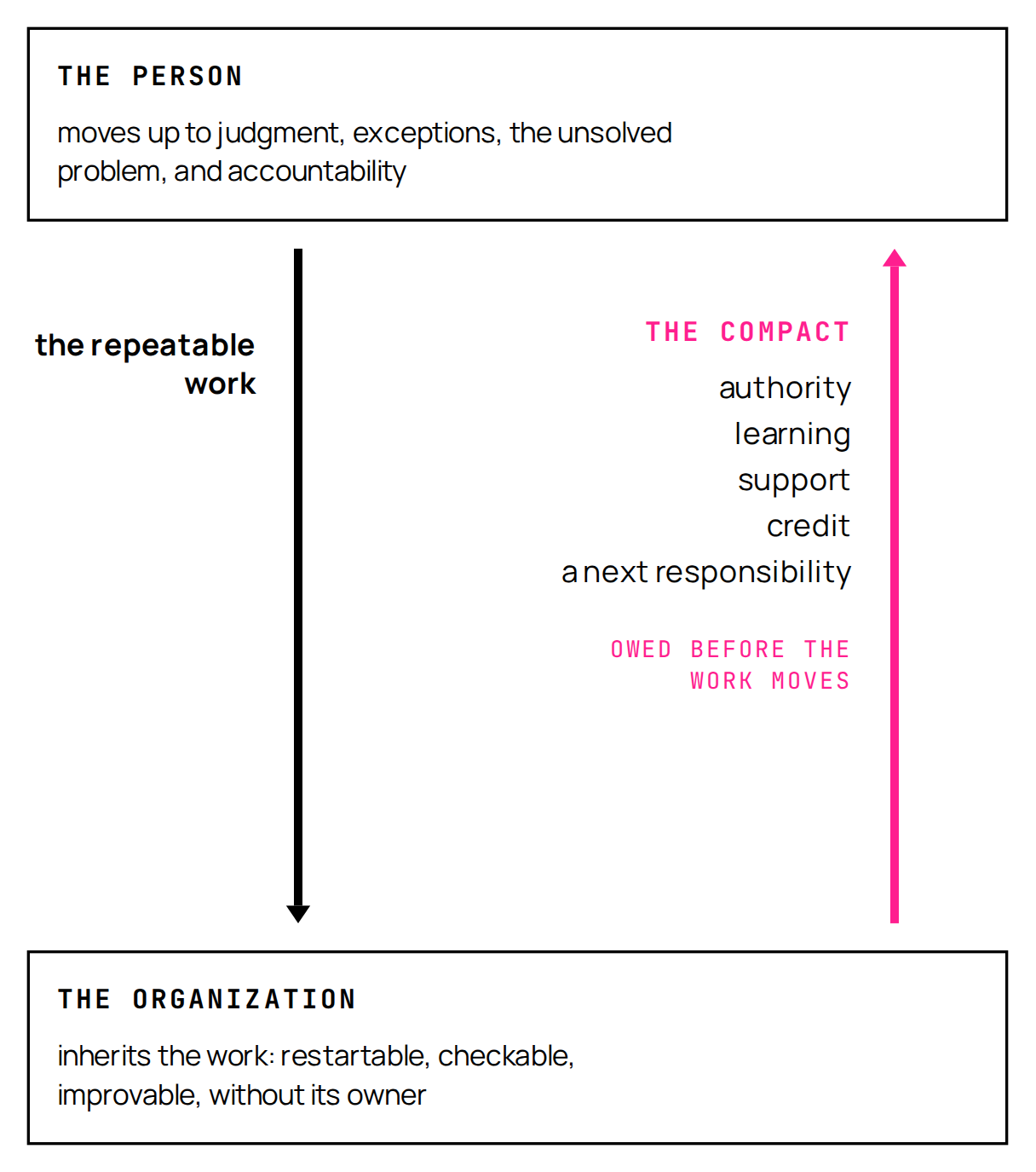
One more weight on the scale before this chapter moves on. Handing over the repeatable work makes your old value portable. It does not, by itself, make you more valuable. The second move needs things you cannot grant yourself: real authority over a next responsibility, access to the learning it demands, support through the transition, and credit for what you transferred. That is the organization's side of this trade, owed before the work moves, not promised after. Where that side is not credible, conditioning the handoff until it becomes credible is not hoarding. It is the trade refusing to become a donation. Chapter nineteen holds the organization to its side. The rest of this book holds you to yours.
That is why the two lines at the center of this book are two lines and not one. The organization must inherit the work. The person must outgrow it. Inheriting is the first move. Outgrowing is the second, and if you only ever run the first, you have not become the thing this book is named after. You have made yourself easy to replace, on schedule, with your own documentation.
Where they come from
I can tell you how one gets formed, because the description above is not a theory to me. For most of my career it was the thing wrong with my resume.
I changed positions, companies, and whole industries often enough that the market priced me as a flight risk. Recruiters saw instability. What the moves actually produced was something no stable career can produce: every arrival made me a beginner again, and a beginner is temporarily immune to the local common sense. You ask the questions everyone stopped asking years ago. Why is this done this way. Why do we send this report to people who do not read it. The stupid questions, which are the right questions, and which reliably make the room uncomfortable, because the honest answer to most of them is that the reason left the company in 2011.
Each industry handed me patterns the next one lacked. Watch how a logistics operation thinks about handoffs and you will never see a marketing department's workflow the same way again. The pattern library is the asset. The friction is the signature. If your questions never irritate anyone, you are probably asking about things the organization already understands.
But I have to close a door here, because this paragraph is one comfortable misreading away from a permission slip. Job-hopping does not make you a Blank Collar. Most people with five employers in ten years are simply people with five employers. The test is whether the crossings produced transferable sight: name one pattern you saw in the second industry because of the first, and name the decision it changed. If nothing comes, the moves were just moves.
And crossing industries is only the loudest way to form one. The quiet way, open to anyone, is crossing domains inside a single job, which is what the second half of this book is about.
The part everyone gets wrong about creativity
The trait most often attached to people like this is creativity, and the word has been so worn down by agency brochures that I want to define the working version before someone hears art.
Creativity here means three moves in sequence. Seeing that an arrangement nobody has tried might work. Building the version of it that could actually run. And shaping it so that other people adopt it, because an innovation nobody uses is a hobby. Judgment, invention, adoption. The middle move is the one machines now do cheaply, and that changes where the value sits. When generating options costs nothing, having options is worth nothing. What is scarce is knowing which of the two hundred options is worth keeping, and getting an organization of humans to carry it.
This is also the fairest way to say something about white collar work that could otherwise sound like an insult. White collar work was never built to be creative. It was built to be repeatable, because repeatable was the only thing the verification apparatus could verify. In that system, variance is a defect, and the people who suppressed their own variance were not failing. They were being professional. The role paid them to be interchangeable, and they were right to take the money. Then somebody built a machine that is better at being interchangeable than any human will ever be, and the suppressed variance turned out to be the only part worth paying for.
Two people, one year
Let me make the definition do some work. The two people that follow are composites, assembled from people I have managed and worked beside; the pattern is one I have watched enough times to call a pattern.
Both are analysts on the same team. Both discovered the same AI tools in the same month, and both immediately found that the reporting work that used to fill Tuesday now takes forty minutes. From the day they start, their dashboards are identical. Same output, same deadlines met, same review scores. They will stay identical for about a year.
The first analyst banks the difference. The machine writes the report, the analyst smooths it, sends it, and gets Tuesday back. It feels like winning, and in the short term it is. But look at the trade honestly: the documented part of the job is now performed by the machine, and the analyst is adding nothing the machine did not produce. Every month, a thinner layer between the tool and the deliverable. No learning of the business either, because the reports were how you learned the business. This analyst is becoming, one Tuesday at a time, perfectly inheritable.
The second analyst spends the difference. The machine writes the report, and the freed hours go where the report used to prevent them from going: sitting with the operations team to find out why the number moved, tracing a definition nobody could supply, learning the adjacent function's work well enough to question it. This analyst hands the machine more of the checklist every month, on purpose, and every handoff buys back time that gets converted into the kind of knowledge that never appears in a report.
I gave this difference a sentence years before I could explain the mechanism, and I have not improved on it since: there are people who use AI so they don't have to learn anything, and people who use AI so they can learn everything.
The cruelty of it is the timing. For a year, management cannot tell these two apart, because the instruments management owns measure output, and their output matches. Then the team is reorganized, or the tool gets better, or a harder problem arrives, and they separate permanently. The first analyst discovers the role can now be described completely, which is the discovery chapter three warned about. The second has become the person you call when the procedure fails. Nobody demoted the first analyst. The demotion was quiet, and it came through the same tool the second one used to do the opposite. I built this parable with both analysts at the same desk, with the same tool and the same freedom, so the difference between them is the choice and nothing else. Real companies are not parables. Whether the second path is actually open is the organization's side of the bargain, and chapter nineteen collects on it.
One of them passed the operational test. The other never took it.
Why your systems reject them
Now put the definition next to your talent machinery and watch the two argue.
Your hiring filter wants a legible career: linear titles, one lane, a recitable process, references who can describe the work in standard terms. Every one of those signals is a signal of inheritability. The wandering resume, the decisions owned instead of methods recited, the questions that annoyed the last employer: those are the formation marks of the thing you claim to want, and the funnel reads them as damage. Twenty years of rigor in your hiring process has amounted to a procurement program for the most automatable people in the market, executed at a premium, and audited annually for quality.
Promotion runs the same filter at higher altitude. Understand precisely what the review form can and cannot hold, because the distinction is the whole problem. A Blank Collar's judgment is accountable and observable: you can name the decisions this person owned, what each one cost or saved, and who was standing behind them when one went wrong. What that judgment is not is repeatable. It does not reduce to a procedure someone else could file and rerun, and the form is built to file procedures. So the person whose value is that departments stopped colliding this year, a real, observable, expensive-to-lose contribution, submits a self-assessment that reads thinner than the one from the colleague who executed a documented process forty times. Tonight, if you want, run the check yourself: line up your last five promotions and ask how many went to someone whose whole contribution could be walked through, step by step, on request. That is not a coincidence. It is the filter, working.
I am not asking for guilt. I am asking you to notice that the filter was built on purpose, for a world where the person who could be walked through was the safe hire. The machines have inverted the safety. The recitable process is now the layer a software update absorbs, and the contribution your forms cannot file is the layer that keeps its price.
One warning before you swing to the other extreme. You cannot hire for blankness, because blankness does not interview. The person who claims to be un-documentable is usually just disorganized; the real thing only shows up in the doing. And one caution about the restless-mover picture from the last chapter: the freedom to switch lanes is not evenly available. Caregiving, a disability, an accommodation, a visa tied to one employer, or a pension lock can hold a capable person in one place, and stability of that kind is not a defect to grade down. What this book values is the cross-domain sight itself, which a person can build without ever changing employers. The Blank Collar label, card, and evidence pattern do not belong in individual screening or selection. Real hiring must use separately validated, role-specific criteria with access and accommodation designed in from the start. How organizations can stop filtering out transferable capability without turning this framework into a personnel instrument is a later chapter.
The identity is open. That is the strange, hopeful fact underneath this whole book, and I will earn it properly in Movement III: the second analyst was not born different from the first. The difference was a trade made with the same tools, and the trade is available to almost anyone whose job currently looks like a task list.
But hope needs evidence, and so far all I have given you is a definition and a pattern. If this person is real, the market should already be repricing them, and the people on the wrong side of the trade should already be feeling it. That is checkable. The numbers exist, they are moving fast, and they are stranger than either the panic or the reassurance you have been sold.
The next chapter reads them.